Table of Contents
[🇩🇪 - Softe Skills, harte Zahlen]
💸 The Feel-Good Fallacy: Why Psychological Safety is a Hard Economic Lever
Bring up “psychological safety” in a room full of executives, and you can practically hear the eyes roll. To a leadership team staring down tight margins, it sounds like expensive coaching fluff. Empathy doesn’t ship features. Leave the sticky notes and team-building to the Agile Coaches; the business needs efficiency.
Because there is nothing as efficient as paying senior engineers €80,000 a year to watch a project burn while on mute.
This mindset gets the equation completely wrong. Psychological safety isn’t a soft skill. It is a hard economic lever.
I’ve written before about the biological trap of demanding vulnerability from the exact people who control your mortgage, and the brutal reality that overloaded managers simply lack the capacity to build psychological safety. But if you don’t care about the biology or the calendar math, that’s fine. Let’s just follow the money.
🤐 The Anatomy of Silence: Why Hiding Mistakes is the Default
When researching medical error rates in hospitals, Amy Edmondson discovered an uncomfortable reality: Teams with the worst psychological safety do not make fewer mistakes. They just hide them better. In a hospital setting, hiding a mistake can kill a patient. In tech, it can kill the company.
When organizational design forces a single manager to control both your daily work and your annual performance review, speaking up about a failing project is just an elaborate way to set fire to your own raise. So, people do exactly what self-preservation dictates. They survive. They nod in the planning meeting. They watch the deadline slip. They quietly step out of the blast radius.
This silence is not a rare edge case. It is the default operating system of the traditional command-and-control playbook.
Academic studies into corporate communication reveal that up to 85 percent of employees fail to speak up about a critical concern at work. If you have a room of ten engineers, eight of them will watch a project catch fire and quietly close their laptops.
You do not need a cartoonishly evil boss to create this dynamic. Just a normal, permanently stressed-out one will do fine. Most of the time, the silence is far more subtle. It is the junior developer deciding not to interrupt a structurally overloaded manager. It is the senior engineer who warned about technical debt three times and simply gave up.
There is a literal cost attached to this silence. Gallup’s workplace data indicates that when employees check out to protect themselves, the company loses 18 percent of their annual salary to lost productivity. That €80,000 engineer we talked about earlier? You are paying €14,400 a year just for their silence.
When an entire department slips into the Anxiety Zone, these incidents compound daily. Small sparks travel silently down the delivery pipeline until they hit production, burning your budget in four measurable ways: late error discovery, employee turnover, opportunity costs, and the friction of isolated departments.
🧮 The Hidden Ledger: How to Calculate the True Cost of Silence
(Note: If formulas make your eyes glaze over, here is the plain English version: The financial damage of a toxic culture is simply the cost of replacing the people who quit, plus the cost of fixing the late bugs they were too afraid to report, plus the money wasted building the wrong things, plus the cost of departments refusing to talk to each other. Feel free to skip the math and jump straight to the real-world case study.)
Finance departments love equations. So let’s build two, just to speak their language.
The financial damage of a punitive culture is highly predictable. We can start with the Simple Ledger, a formula that tracks only the immediate, undeniable cash burn of an unsafe environment:
CDirect = (NTurnover × CReplacement) + (NLateBugs × CFix)
- CReplacement (Turnover Tax): Typically 1.5x to 2.13x an annual salary, factoring in recruiting, notice periods, and the 4-6 month ramp-up time.
- CFix (The Late Discovery Tax): The exponential cost of patching a bug in production versus catching it in design.
No finance director will argue with the Simple Ledger. But it only accounts for the visible explosions. To calculate the true systemic damage of silence, we need the Advanced Ledger.
This formula takes the direct costs and adds the invisible friction of opportunity costs and departmental silos:
CTotal = CDirect + COpportunity + CSilo
Where those invisible costs are defined as:
- COpportunity (The Pivot Lag): This is the capital burned while a team builds the wrong thing because they are too afraid to push back on flawed requirements or deliver bad news to decision-makers. It is calculated as:
COpportunity = (BMonthly × TDelay) × (1 - PSalvage)
(Where B is the monthly burn rate, T is the time delayed, and P is the percentage of work that is actually salvageable once the pivot finally happens). - CSilo (The Information Silo Tax): The cost of cross-departmental silence. As companies grow past the 150-employee threshold, the cognitive limit famously known as Dunbar’s Number, intimate social trust biologically fractures. Departments start protecting their turf, causing misaligned launches and redundant work.
To see how aggressively this scales, apply this math to a mid-sized tech company with 150 employees and an average salary of €80,000. If this organization operates with low psychological safety, the estimated annual liability of the Advanced Ledger is roughly €9.35 million.
Let’s call it the “Ouch Ratio”: For every €1 spent on payroll in a low-safety culture, €0.78 is lost to the Hidden Ledger.
📉 The Reality Check: The €50,000 Database Bug
Let’s look at how the Simple Ledger plays out in reality. The internal blended hourly rate for engineering is €60. A junior developer spots a fundamental flaw in a database migration plan.
Fixing the flaw right now, during a code review, will take half an hour of pair programming. The cost is €60. But if that flaw makes it to production, crashes the database, and forces you to pay a team emergency weekend rates to fix it, the conservative cost is €15,000.
Now add the cost of turnover. Even if we ignore the massive multiplier of lost productivity and only calculate the hard European recruiting fees and direct onboarding hours to replace that junior developer, you are burning a highly conservative €35,000.
Team A operates in the Anxiety Zone. The junior developer is intimidated by the senior architect, and they simply cannot risk looking stupid in front of the engineering manager who sits in the same review and controls their salary. They do the unconscious math in their head, realize the personal risk of speaking up outweighs the reward, and stay silent.
The flawed migration goes live. The database crashes right on schedule. The company burns €15,000.
Burned out by a supposedly “blame-free” post-mortem that quickly devolves into a witch hunt, the junior developer mentally checks out. They either leave the company or default to quiet quitting, safely collecting their salary while doing the absolute bare minimum. The company burns another €35,000 in replacement costs. The total cost of silence for this single incident is €50,000.
Team B operates in the Learning Zone. They have a separated disciplinary structure and a dedicated Agile Coach. The junior developer feels secure enough to voice a concern without the fear of looking incompetent.
The senior developer listens and validates the catch. They fix the architecture together. This doesn’t just save money; it creates an immediate learning loop. The junior developer gains deep, hands-on architectural knowledge, and the team’s collective competency increases. The cost is €60. Retention remains stable. The total cost of speaking up is €60.
The difference is €49,940. That is the direct tax of just one single incident, paid simply to maintain the traditional hierarchy of an overloaded dual-role.
🩹 The Grey Area: Death by a Thousand Paper Cuts
Executives often read about a €50,000 database crash and think, “That is an extreme edge case. That does not happen here every day.”
They are right. The explosive failures are rare. But the financial drain in the grey area is relentless. When you lack psychological safety, you don’t just lose money to catastrophes; you bleed capital every single day through a thousand paper cuts.
Here is what the Hidden Ledger looks like on a normal Tuesday:
- Pull Request Tennis: A junior developer spots a messy architecture choice by a senior engineer but is afraid to call it out directly. Instead of a 5-minute conversation, they leave a vague, passive-aggressive note on Jira. The senior engineer gets defensive. The PR bounces back and forth for three days. Congratulations, you just paid €1,500 in engineering salaries for two people to protect their egos.
- The Meeting After the Meeting: A director proposes a flawed roadmap. The room of 12 people nods and agrees. As soon as the Zoom call ends, four engineers immediately jump into a private Slack huddle for 45 minutes to complain about why it will never work. It is the most team alignment you have achieved all quarter, and it happens entirely off the books.
- CYA (Cover Your Assets) Engineering: A team is handed an impossible deadline. They know they will fail, but saying “no” is unsafe. Instead of writing code, they spend 20 percent of their sprint meticulously documenting every blocker, dependency, and external delay. They aren’t building software; they are building a fire protection system for their performance review.
You might avoid the €50,000 disaster, but this everyday friction destroys your flow and your margins. The math of the Hidden Ledger still applies; it just drains your budget quietly.
📊 The Evidence: Why the Cost of Change Math is Bulletproof
If anyone thinks the leap from €60 to €15,000 is exaggerated, introduce them to the Rule of 100.
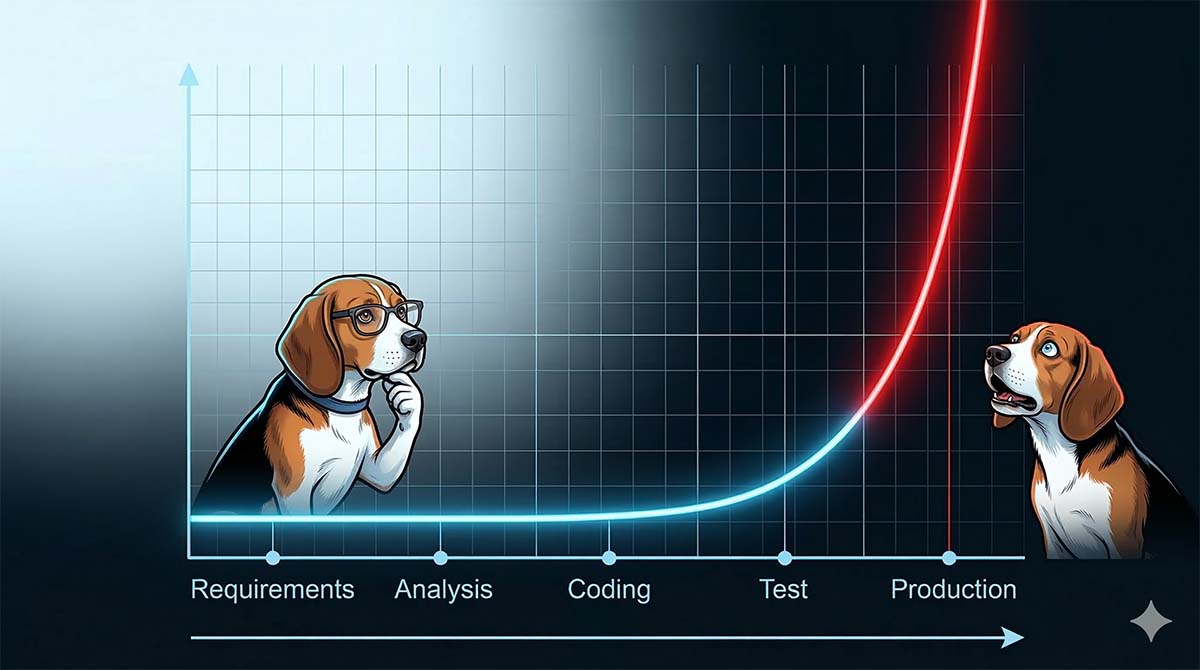
The Cost of Change Curve: Silence ensures bugs travel to the most expensive end of the spectrum.
In 1981, software engineering pioneer Barry Boehm codified the “Cost of Change” curve, a premise repeatedly validated by institutions like the National Institute of Standards and Technology (NIST). The rule is as simple as it is unforgiving: the cost of finding and fixing a defect grows exponentially the further it travels down the development pipeline.
If a fundamental flaw takes one hour and costs €60 to fix during a code review, it costs €600 to fix during integration testing, and easily €6,000 to €15,000 to fix once it crashes in production. This is the practical application of the Rule of 100.
Every time an engineer bites their tongue during a planning meeting or a code review, they are actively pushing a defect to the right side of Boehm’s curve. Psychological safety is not a cultural perk; it is the only operational mechanism that consistently pulls error detection back to the left side of the graph—where it is cheap to fix. Silence simply guarantees that bugs travel to the most expensive end of that spectrum.
And what about the €35,000 turnover cost? A massive study analyzing millions of employee reviews found that a toxic culture is 10.4 times more powerful than compensation in predicting employee turnover. Rigorous meta-analytic research aggregating tens of thousands of employees proves that a lack of psychological safety is a primary driver of that exact toxicity and attrition. You simply cannot out-pay the desire to escape an Anxiety Zone.
Silence is the vehicle that transports a €60 problem into a €50,000 disaster.
⏱️ The Opportunity Cost: Malicious Compliance
The Advanced Ledger highlighted the damage of the Pivot Lag (COpportunity). But why does that lag happen in the first place?
In a structurally overloaded hierarchy, engineers do the unconscious math and realize that challenging the roadmap carries too much interpersonal risk. They retreat into malicious compliance. They build exactly what they were told to build, even if they know it is the wrong thing.
According to industry data from Pendo and the Standish Group, up to 80 percent of features in standard enterprise software are rarely or never used by customers. Companies burn millions of euros building useless code because preventing bad features requires a developer to look at a Product Manager or even stakeholder and say, “This requirement does not make sense.”
If your organizational design places disciplinary power directly in the middle of that conversation, that pushback will never happen. You achieve maximum local efficiency while entirely missing the market.
🔗 The Safety Throughline: Connecting the Ledger
Make no mistake: none of these financial leaks are isolated operational problems. They are all behavioral symptoms of the exact same root cause: the perceived interpersonal risk of speaking up.
- The Late Discovery Tax (CFix) is driven by the fear of looking incompetent.
- The Turnover Tax (CReplacement) is driven by the chronic exhaustion of self-protection.
- The Opportunity Cost (COpportunity) is driven by the fear of challenging authority.
- The Silo Tax (CSilo) is driven by a fractured lack of enterprise-wide trust when navigating Dunbar’s Number.
Every single one of these costs is just a different tax on missing psychological safety.
🚀 The Upside: How Psychological Safety Becomes an Engine for Speed
Psychological safety is not just an insurance policy against expensive bugs. It is the core engine for speed. High-safety teams ship consistently faster and pivot with far greater agility.
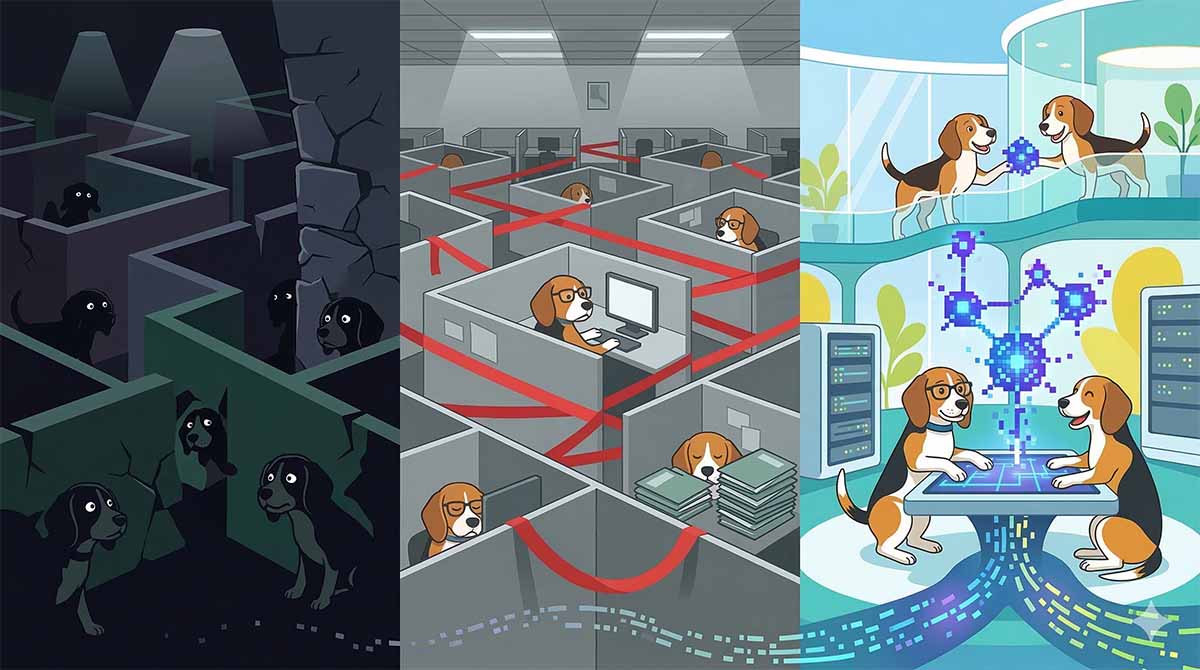
Ron Westrum’s model: You cannot build an elite engineering organization on top of a pathological hierarchy.
The DevOps Research and Assessment (DORA) data proves this using sociologist Ron Westrum’s culture model. Elite engineering organizations share a generative (performance-oriented) trait. Information flows freely. People are not punished for bringing up bad news. Safety is a direct, mathematical predictor of IT performance.
🛡️ The Structural Solution: Why Lateral Leadership is the Financial Linchpin
If the traditional hierarchy is the financial bottleneck, how do you fix it? The answer is structural. You have to separate the powers.
When you split disciplinary leadership (individual performance and salary) from lateral leadership (flow and coaching), you bypass the biological threat response. Because an Agile Coach does not write the annual review, the team stops playing defense. Instead of watching a project catch fire, they will gladly hand you the matches without fear. They can admit failures early, challenge bad roadmaps, and focus on building the right product instead of managing their own self-preservation.
The lateral leader facilitates the uncomfortable pushback against bad features. They are not a feel-good luxury. They are the necessary structural counterbalance to the hierarchy, and the math proves it: A landmark ROI analysis by MetrixGlobal for a Fortune 500 company demonstrated that dedicated organizational coaching yields a staggering 788 percent return on investment, driven primarily by salvaged productivity and halted employee turnover.
🛠️ Measurability: Stop Guessing, Start Tracking
You cannot fix what you do not measure. But you have to measure the right things.
Most traditional companies, for example, look at their turnover rate. Relying on attrition as a health metric is a massive operational mistake, especially in markets with strong labor laws like Europe. Thanks to strict worker protections and long notice periods, frustrated engineers rarely quit on the spot. They stay on the payroll, default to quiet quitting, and do the absolute bare minimum. Your retention rate might look great on paper, but your value creation has ground to a halt.
Employee Net Promoter Scores will not save you either. A team stuck in the Anxiety Zone will simply give a polite eight out of ten on a survey to avoid drawing management’s attention. It is a vanity metric. Dying in beauty. If you want the truth, you have to look at actual Kanban metrics combined with qualitative data.
Track your System Lead Time and Work in Progress. Are work items moving smoothly through the system, or is work piling up in the review column? If a simple code review takes three days because everyone is carefully covering their tracks and avoiding a clear decision, your flow is broken. Fear creates friction, and friction destroys flow. If your delivery times are extending without a technical reason, you have a lack of psychological safety.
Establish regular Team Health Checks, conducted by your lateral leaders. Stop asking if people are happy. Ask if it is safe to make mistakes. Ask if they can push back against unrealistic deadlines without fear of retaliation.
When you put the quantitative Kanban metrics next to the qualitative Health Checks, the Hidden Ledger becomes fully visible. You stop looking at abstract budget overruns and start seeing the exact mathematical correlation between a drop in psychological safety and a massive, expensive spike in your Lead Time.
🛑 The Bottom Line: Why Silence is the Most Expensive Line Item
Every time a leadership team demands efficiency by increasing spans of control and overloading a single manager, they are actively sabotaging their own profit margins. Refusing to split disciplinary, functional, operational, and lateral leadership creates a structural bottleneck for the truth.
Calling psychological safety a “soft skill” is just a socially acceptable way to set money on fire. Psychological Safety is the absolute financial prerequisite for sustainable engineering. A culture where silence is safer than candor will always be the most expensive line item on your balance sheet.
📌 TL;DR: The Hidden Ledger at a Glance
For everyone who scrolled straight to the bottom, here is the hard economic reality of psychological safety:
- Hiding mistakes is expensive. When employees stay silent out of fear, bugs travel quietly into production, where fixing them becomes exponentially more expensive (Rule of 100).
- Toxicity beats compensation. A punitive culture drives massive turnover and quiet quitting. The cost of replacing an engineer destroys your budget (10.4x multiplier).
- Silence kills innovation. Without safety, no one dares to challenge flawed stakeholder requirements. The team obediently builds useless features, generating massive opportunity costs.
- Measurability beats guessing. Vanity metrics like ENPS or pure turnover rates hide the real problem (“Dying in beauty”). Only the combination of hard Kanban metrics (Lead Time) and qualitative health checks makes the Hidden Ledger fully visible.
- The solution is structural. A single manager controlling both your salary and your daily work prevents honesty. Separating disciplinary power from lateral leadership is not a feel-good luxury; it is a hard financial necessity (788% ROI).
🧾 The Receipts: Meta-Analyses, Scientific Sources, and Data
If your executive board prefers hard empirical evidence before they rethink the hierarchy, put these foundational studies and massive meta-analyses on the table. (A meta-analysis is the gold standard of evidence, aggregating the data of dozens or hundreds of independent studies).
- The Ultimate Proof of Psychological Safety (Meta-Analysis): To permanently end the debate on whether safety drives performance, cite Frazier et al.’s 2017 meta-analysis in Personnel Psychology. They aggregated 136 independent studies representing over 22,000 individuals, proving definitively that psychological safety is the primary driver of team performance and learning. Read the meta-analysis here.
- The Biological Limit of Corporate Cohesion (Dunbar’s Number): To explain why cross-departmental silos and the CSilo tax emerge so predictably at the 150-employee mark, reference Robin Dunbar’s anthropological research on human cognitive limits. Read about Dunbar’s Number here.
- The Exponential Cost of Late Bugs (The Rule of 100): If you need to prove the 100x cost multiplier for production bugs, use Barry Boehm’s classic Software Engineering Economics. This was later validated on a massive enterprise scale by the National Institute of Standards and Technology (NIST). Read the NIST report here.
- The 10.4x Turnover Multiplier: To prove the €35,000 replacement cost and the impact of a toxic environment, cite the massive analysis of 1.4 million Glassdoor reviews by Sull, Sull, and Zweig (2022) in the MIT Sloan Management Review. They found that a toxic corporate culture is 10.4 times more powerful than compensation in predicting a company’s attrition rate. Read the analysis here.
- The Opportunity Cost of Useless Features: To show stakeholders that up to 80% of enterprise software features are rarely or never used, cite the Pendo & Standish Group Feature Adoption Report. Their analysis of anonymized product usage data proves that engineering departments waste massive amounts of R&D budget on building the wrong things. Read the Pendo research summary here.
- The Enterprise Value of Safety: For the mathematical proof that high-safety cultures predict elite IT performance, you need the DORA metrics published in Accelerate (Forsgren, Humble, Kim; ISBN: 978-1942788331). Pair this directly with Google’s famous Project Aristotle, which proved psychological safety is the absolute prerequisite for high-performing teams. Read the definitive feature on Project Aristotle here.
- The 788% ROI of Lateral Coaching: To prove that lateral, non-evaluative coaching structures yield hard financial returns, cite the landmark ROI analysis by MetrixGlobal for a Fortune 500 company, which calculated a 788% ROI driven by salvaged productivity and halted employee turnover. You can pair this with Theeboom et al.’s 2014 meta-analysis proving the psychological mechanism: dedicated, non-disciplinary coaching has significant positive effects on team performance and goal-directed self-regulation. Review the Theeboom meta-analysis here.
- The Anatomy of Corporate Silence: To back up the claim that silence is a systemic response to hierarchy rather than just “bad bosses,” cite the foundational study by Milliken, Morrison, and Hewlin (2003) in the Journal of Management Studies. They quantified how and why employees withhold critical information from leadership out of self-preservation. Read the study here.
- The 18% Disengagement Tax: For the hard math on quiet quitting and inner withdrawal, Gallup’s workplace research calculates that actively disengaged employees cost an organization approximately 18 percent of their annual salary in lost productivity, rework, and missed days. Review Gallup’s workplace data here.