Table of Contents
[🇩🇪 - Vier Rollen, Fünf Mächte]
🪑 The Hat Stack: When “Flat” Quietly Means “Concentrated”↑
Markus opens an email from Lehmann on a Tuesday morning. The subject line is “Clarification before Q3 planning.” The message itself is shorter than the subject line deserves. The leadership team is considering a flatter structure. Headcount unchanged. The Team Coach role would be “absorbed into the People Lead function”. The Tech Lead role would be “distributed across senior engineers”. Markus would still be the People Lead. He would also become the coach. And, by implication, the gentle psychological safety net for fourteen engineers whose annual ratings he writes in November.
Markus pauses on the Tech Lead line. That one, actually, is right. Distributing technical decisions across the engineers is exactly how it should work. He makes a note. Two sentences later the Coach absorption lands, and the note stops mattering.
Lehmann’s next sentence stops Markus mid-scroll. “Curious how you would balance these dimensions - let me know by Friday.”
Markus blinks. He reads it again. Then again a third time, more slowly, because he has just realised something unusual: Lehmann is not telling him what is going to happen. Lehmann is asking. Which means there is, for once, a window in which the answer matters. Markus cannot remember the last time that window was open.
He forwards the email to Agile Coach Lisa with one line: “Can we talk before Thursday?”
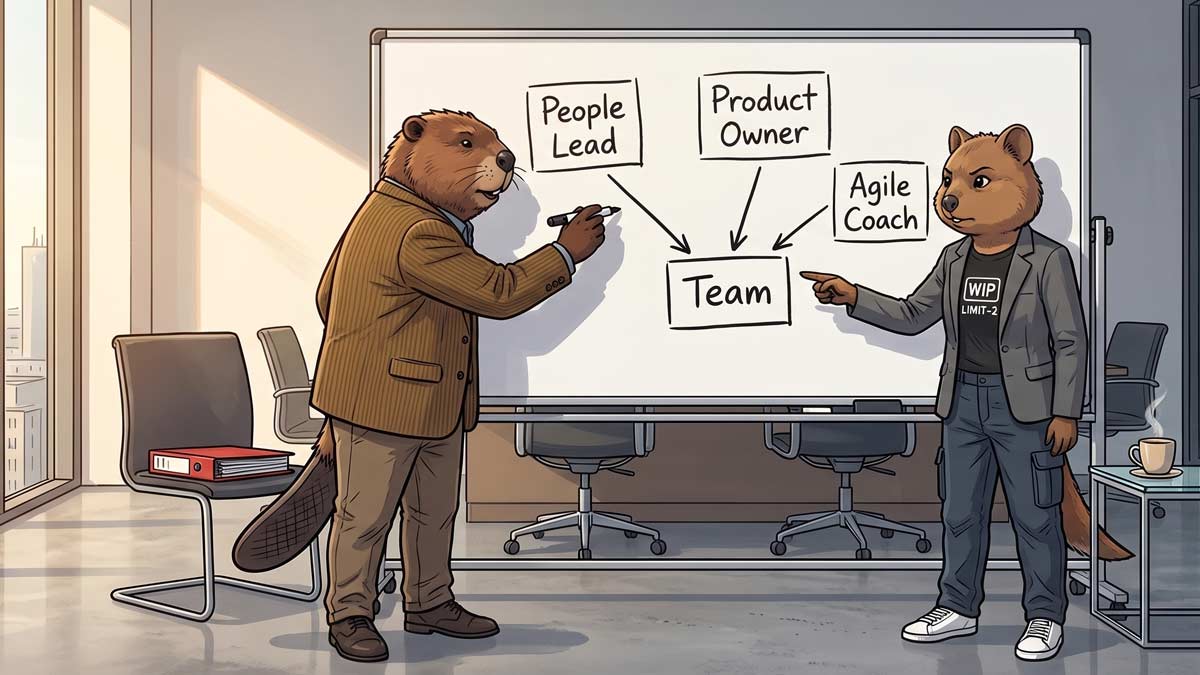
Before Thursday. Four boxes on a whiteboard, a cup of coffee, and a conversation that should have happened six months ago.
📚 Five Powers: Why the Org Chart Won’t Name Them↑
The org chart names the boxes. It is silent on what kind of power each box actually carries - because naming it makes it contestable.
In 1959, social psychologists John French and Bertram Raven published The Bases of Social Power. The paper is short. The taxonomy is durable. They identified five distinct mechanisms by which one person gets another to do something:
- Reward Power. The ability to grant something the other person wants. Salary, bonus, promotion, a calendar invite to the conference in Lisbon.
- Coercive Power. The ability to impose something the other person does not want. A poor performance rating, a denied promotion, an Abmahnung, a contract not renewed.
- Legitimate Power. Formal authority embedded in the org chart. The right to sign, approve, escalate, decide. Power that exists because the box on the slide says it does.
- Expert Power. Influence based on knowledge the other person needs. The architect who knows where the legacy tariff exception is buried. The senior who can actually read the stack trace.
- Referent Power. Influence based on identification, trust, or personal regard. The leader people follow because they want to, not because they have to.
The taxonomy describes mechanisms, not personality types. One person can embody several powers at once. Most managers attempt to embody all five, because the org chart is silent on which ones the role is actually supposed to carry. And which it isn’t.
This silence is where things start to break.
🪞 The Servant Leader Paradox: Why One Person Cannot Embody All Five↑
The well-known image of leadership wants the manager to be everything. Coach in the morning, judge in the afternoon, technical mentor over lunch, cultural anchor at the offsite, and the person who decides who gets the bonus in November. The manager who is supposed to be all five powers at once is the eierlegende Wollmilchsau [lit. “egg-laying wool-milk-sow”: a creature that does everything] of the org chart: designed by a steering committee, biologically impossible.
The damage starts where Coercive and Referent power meet. Edmondson’s body of work on psychological safety documents, across two decades of replication, that team climates with high disciplinary visibility produce systematically less candor, less risk-taking, and less surfacing of error.
The mechanism the literature converges on is straightforward: people do not volunteer ignorance or failure to observers who also score them. The instant a developer knows the person asking “how is it going?” is the same person rating them 1-to-5 by Friday noon, the answer becomes performance, not signal.
Coercive power is in the room. Referent power has left the building.
The full mechanism, with the underlying biology, lives in the earlier piece on psychological safety.
A second collision happens between Expert and Coercive. If the same person who tells the engineer the tariff logic needs refactoring is also the person who scores them on delivery, the engineer hears a directive, not a discussion. Expert influence requires the freedom to disagree without consequence. Coercive power suffocates that freedom. The engineer will agree, then quietly do the safest thing, which is rarely the best thing.
The third collision is Niklas Luhmann’s contribution. In Soziale Systeme (1984), Luhmann argued that complex systems differentiate by function. A team is itself a system. It cannot be properly observed by an actor who is also part of its operational steering, because that actor has structural blind spots dictated by their position in the hierarchy. The People Lead reports upward. Their observations of the team are pre-shaped by what they need to report. They cannot, structurally, see the team clearly. Someone outside the disciplinary chain has to observe the team, without the distortion that one’s own position in the hierarchy inevitably creates.
(nb: The application to reporting hierarchies is derived from Luhmann’s functional differentiation argument; the concept is his, the org-chart reading is mine.)
Wear all five hats and biology conspires with sociology to make you an unstable observer of your own system.
There is a cognitive layer underneath this. Sweller’s Cognitive Load Theory distinguishes three load types: intrinsic (the task itself), extraneous (how it is presented), and germane, Sweller’s term for the effort of building new mental models. Asking one person to operate strategic, operational, individual, and meta-systemic perspectives simultaneously multiplies cognitive load rather than partitioning it.
The mental model required for a Product Owner thinking in quarterly market windows is structurally different from the mental model required to debate an architectural trade-off, which is different again from the mental model required to listen to an exhausted engineer in a 1:1. These schemas crowd each other out; switching between them carries the same context-switching tax that destroys engineering throughput, applied to the brain that is supposed to be steering.
If you have read the Utilization Fetish, the problem is familiar. A human juggling four mental models pays Weinberg’s context-switching tax on every transition. The leader who is everything is thrashing - performing constantly with minimal productivity.
🧩 The Four-Role Split: What Modern Organizations Should Actually Do↑
The standard modern response to the all-in-one manager problem is to split the leadership job. The names vary by framework. The clean version, the one that survives contact with both the sociology and the operational evidence, has four roles. One of those four roles is the team itself.
- Product Owner. Owns the what and the why. Holds Expert power on market and customer, and a scoped form of Legitimate power: the right to set backlog priority and to accept or reject deliverables against business intent. Carries no formal authority over the people doing the work.
- People Lead (also: Engineering Manager, Line Manager). Owns the who. Holds Reward, Coercive, and a scoped form of Legitimate power: headcount decisions, formal performance management, promotion, salary bands, and escalation up the disciplinary chain. Carries the disciplinary contract and nothing else.
- Team Coach (Agile Coach, Scrum Master, …). Owns the how it flows. Holds Referent power and a scoped form of Legitimate power: the right to call out process violations and to facilitate the team’s working agreements. Carries no disciplinary authority and no architectural authority.
- The Team itself. Owns the how it is built. Holds Expert power on the system and a scoped form of Legitimate power: the right to make architectural decisions inside its own domain. Holds these collectively, not via a Tech Lead role above the team.
Four roles, five powers. The arithmetic works precisely because Expert power on the technical work belongs to the Team role collectively. The fourth role holds the fifth power.
This is where most engineering organizations get the design wrong. They split the leadership job into the first three roles and then re-introduce a fourth individual role called Tech Lead, intending to give it Expert authority over the team’s technical decisions. The intent is reasonable. The result is a structural anti-pattern with predictable consequences.
🚧 The Wrong Fourth Role: Why the Tech Lead Recreates the Bottleneck↑
Three independent lines of evidence converge on the same conclusion: pulling Expert power out of the team and concentrating it in an individual Tech Lead role reduces the team’s effective capacity, slows architectural decisions, and produces exactly the in-team hierarchy the four-role split was designed to dissolve.
🏗️ Line 1 - Conway’s Law: Decision Bottlenecks Become Architectural Bottlenecks↑
Conway observed in 1968 that systems mirror the communication structures of the organizations that build them. The corollary, made explicit by the DORA research published in Accelerate, is that decision bottlenecks become architectural bottlenecks. A team with a designated Tech Lead routes its architectural decisions through one person.
The system the team builds will, over time, exhibit the same single-point-of-decision pattern.
Components requiring cross-cutting decisions wait for the Tech Lead’s attention. Components the Tech Lead has personal context on advance faster. The architecture grows asymmetrically along the contours of one person’s attention budget, and the throughput of the team is capped at whatever that one person can review in a week.
🧠 Line 2 - Collective Intelligence: Conversational Equality Beats Individual Brilliance↑
Anita Woolley and colleagues, in Science (2010), found that group performance on cognitive tasks correlates with social sensitivity, equality of conversational turn-taking, and the proportion of women in the group, and shows essentially no correlation with the average or maximum individual intelligence of the members.
Translated into engineering: a team’s architectural decision quality depends more on whether everyone can contribute than on whether any one member is the smartest in the room. A Tech Lead who functions as the technical decider, however brilliant, structurally suppresses the equal participation that the collective-intelligence research identifies as the actual driver of group performance.
🛡️ Line 3 - Psychological Safety (Lateral): Asymmetric Speaking-Up Risk↑
The pattern Edmondson’s research describes for the manager-employee relationship has a smaller-scale analogue between an institutionally privileged technical authority and the rest of the team. The mechanism is the same one explored in the earlier piece: asymmetric speaking-up risk suppresses the team’s collective knowledge.
The presence of a designated technical authority introduces exactly that asymmetry. A junior engineer is now contradicting not just a peer but the person whose technical judgement is institutionally privileged. The contradiction stays in the junior engineer’s head. The team’s effective IQ drops to the IQ of whoever is willing to argue with the Tech Lead, which is a much smaller subset than the team itself.
📊 The Empirical Add-On - DORA: Distributed Architectural Authority Correlates with High Performance↑
High-performing engineering organizations distribute architectural authority to teams. Low-performing organizations concentrate it in architects, lead engineers, and tech leads. The correlation is one of the most replicated findings in the State of DevOps reports across nearly a decade of data.
Senior engineers matter enormously. Their expertise belongs to the team as a contributing member, an authoritative role above the team is the wrong structure for what they bring. The senior engineer who makes the technical decisions for the team produces a team that cannot make technical decisions without them. The senior engineer who explains their reasoning, defends it as one voice among several, and accepts being out-voted on a fifty-fifty call produces a team that grows.
The first pattern is a Tech Lead. The second is a senior engineer. The vocabulary matters because the structure follows the vocabulary.
The four-role split, with the Team itself holding Expert power collectively, is the only configuration that satisfies all three constraints at once: Conway’s Law leaves no architectural bottleneck, collective intelligence keeps equal participation intact, and psychological safety carries no in-team Coercive shadow from a privileged technical role.
📐 The Flat-Hierarchy Paradox: Why Fewer Layers Need More Role Separation↑
This is the inversion most flat-org advocates miss. Flat structures depend on the four-role split.
A traditional steep hierarchy has four or five vertical layers, and management dilutes power across them: the team lead handles some Coercive authority, the department head handles more, the VP handles the rest. The dilution is not deliberate, but it does spread the disciplinary weight across enough roles that no single person carries the entire bundle. The disadvantage is obvious: information takes weeks to travel up, decisions take weeks to travel back down, and the people closest to the work have the least influence over it.
A flat organization solves the information-and-decision problem by collapsing the vertical layers. C-suite at the top, People Leads in the middle, everyone else on the operational floor. Three levels, sometimes two. Faster, more responsive, closer to the work. But the same Reward, Coercive, and Legitimate power that was diluted across five steep layers now concentrates in two or three flat ones. The People Lead in a flat organization holds more disciplinary weight per person than any team lead in a steep one.
That concentration is the price of flatness, and the four-role split is what keeps it from being paid by the team. The Coach holds Referent power without disciplinary teeth. The Team holds Expert power collectively, without an internal authority role that becomes a bottleneck. The Product Owner holds priority decisions without formal seniority over engineers. The lateral configuration is structural insulation, not extra layers, and it is what lets a flat organization stay honest under load.
Remove them, and flatness means only a smaller number of people holding a larger share of every available power, with fewer structural channels for the team to route around them.
⚠️ The Math Often Does Not Balance: Where Each Power Actually Lives↑
Count the powers across the four roles. The arithmetic only resolves once Legitimate power is treated correctly: as a family of scoped authorities that explicitly fragment, not one indivisible block.
- Reward and Coercive concentrate in the People Lead. By labor-law necessity, not by accident or sociological preference. European employment law treats the right to grant something (bonus, promotion, salary increase) and the right to withhold it (rating, Abmahnung, termination) as two faces of one indivisible disciplinary contract. You cannot give Sarah’s bonus authority to one role and her termination authority to another without producing a procedural collapse the Betriebsrat will dismantle in a single meeting. Reward and Coercive are bound together by statute. They concentrate in one role because the legal framework does not permit them to live anywhere else.
- Legitimate power explicitly fragments. The People Lead holds HR-Legitimate authority: headcount decisions, formal performance management, and escalation up the disciplinary chain. The Product Owner holds Product-Legitimate authority: the right to set backlog priority and to accept or reject deliverables against business intent. The Coach holds Process-Legitimate authority: the right to call out working-agreement violations and to facilitate the team’s process decisions. The Team holds Architecture-Legitimate authority: the right to decide how the system is built within its domain. Four flavors of Legitimate, four roles, no overlap.
- Expert power lives in the Team collectively, with the Product Owner holding scoped Expert power on the market-and-customer side. There is no individual Expert role above the team. The Team’s collective expertise is the Expert power.
- Referent power lives in the Coach. The Coach is the only role in the configuration whose authority depends entirely on trust, not on contract. This is also why the Coach must be structurally barred from any path back into the disciplinary chain. The moment Referent power touches Coercive, biology routes around it.
The five powers do not split into four equal pieces. Two are bound together by labor law and concentrate in one role. One is fragmented across all four roles with explicit scopes. One belongs to a collective. One belongs to the role with no contractual leverage. The arithmetic is asymmetric and the asymmetry is the design.
🩹 The Cost of Concentration: Why Bundling Reward and Coercive Is Not Free↑
Calling the asymmetry intentional does not make it costless. Concentrating Reward and Coercive in one role creates exactly the role conflict the literature warned about, just localized in one job description instead of spread across all of leadership.
The People Lead is still asked to perform some coaching. They still have 1:1s. They still hear about workload, friction, and burnout signals. The moment those conversations veer into territory the engineer perceives as career-relevant, the same shutdown happens that shut down the all-in-one manager. The information disappears.
The fix is scoping the People Lead’s listening to what the disciplinary role can legitimately receive: Duty of Care signals, workload protection, escalation paths, career conversations that are explicitly about career. The skill development conversation belongs to the Coach. The team dynamics conversation belongs to the team’s own retrospectives, facilitated by the Coach. The failed-experiment debrief belongs inside the team.
If the People Lead tries to absorb any of them, the engineering organization will quietly route around the role, because biology will route around Coercive power every time.
This is also why the Hat Stack proposal Markus opened on Tuesday morning is a structural collapse waiting to be ratified, dressed up as a scaling decision. When an organization tells its People Lead to also be the Coach and to also adjudicate technical decisions on behalf of the team, the org chart looks simpler. The power distribution has re-merged everything the four-role split was specifically designed to fragment.
The engineers will respond accordingly: less candor, less risk, less honest signal. The dashboard will not reflect the change for several quarters. By then, the people who would have flagged it have either left or learned to perform. Markus’s reply on Friday is, in effect, a one-page version of this paragraph.
💸 The “We Are Too Small for All Four” Fallacy↑
The standard objection at this point is that small organizations cannot afford four separate roles for one team. A twelve-person company will not hire a dedicated Team Coach. A startup will not separate People Lead from Coach, or Coach from the CTO who also sits in sprint planning. This is true and it does not invalidate the structural logic.
What changes in a small organization is the seating arrangement, not the number of powers. The CTO of a fifteen-person company often holds Expert and Legitimate power simultaneously, with Referent power emerging from the founding-team relationship. This works because the disciplinary contract is light, the reporting is transparent, and the team is small enough that everyone can observe the system without a structural intermediary. The five powers are still there. They are just held in fewer hands by people who can be honest about which hat they are wearing in a given conversation.
The model breaks at scale. The exact threshold varies, but somewhere between thirty and fifty engineers the informal honesty of the small-team configuration stops working, and the absence of role separation starts producing the exact dynamics the four-role split is designed to prevent.
Pretending the small-team configuration scales is what produces twenty-person teams with one exhausted “engineering lead” who has stopped sleeping and started lying to the executive team about how the system is doing.
🌊 Not Every Organization Lives Under This Pressure↑
The role-collision dynamics described above are sharpest in environments where the disciplinary contract is heavy: large enterprises with formal performance management, forced distribution curves, annual rating cycles, and significant variable compensation tied to individual scores.
In organizations that have already abandoned individual performance ratings, decoupled compensation from operational feedback, or operate with strong collective bargaining structures that limit individual managerial discretion, the Coercive lever is structurally smaller. The risk of role collision drops in proportion.
This is the territory the Beyond Observation blueprint maps in detail. The four-role split assumes the disciplinary contract has weight. In organizations where it does not, the four-role split is still useful for cognitive-load reasons, but the urgency is lower. The cleaner the compensation system, the smaller the gap between roles needs to be.
🪜 Three Structural Moves: How to Make the Asymmetry Bearable↑
Three patterns show up consistently in organizations that have made the design hold. No guarantees, no universal blueprints; just levers that can work if someone is willing to pull them.
🧱 Lateralize the Coach↑
The Coach must report on a path that does not pass through the disciplinary chain. If the Coach reports to the Head of Engineering who also writes the People Lead’s review, the insulation is theatrical. The Coach is now indirectly part of the Coercive system, and the team will sense it within weeks. The structural move is dotted-line authority for the Coach role, with the formal review path running through a parallel structure (a Head of People, a Head of Coaching, in smaller organizations directly to the CEO). The arrangement looks bureaucratically expensive. It is the price of honest data.
🧠 Resist the Tech Lead Reflex↑
When architectural decisions slow down or quality slips, the standard reaction is to appoint a Tech Lead to “give the team technical leadership.” The reaction is intuitive. And structurally wrong. It removes technical leadership from the team and concentrates it in one role, producing the bottleneck Conway’s Law predicts and the conversational suppression Woolley’s research measures.
The correct move is the inverse: invest in the team’s collective decision-making capacity. Architectural Decision Records facilitated by the team itself. Pairing or ensemble work on cross-cutting changes. Senior engineers who explain and defend rather than decree. The team that is taught to decide together becomes a team that decides faster than any Tech Lead could review. The team that is rescued by a Tech Lead becomes a team that cannot decide without one.
🔇 Quiet the Coercive Lever Where It Does Not Belong↑
The People Lead’s disciplinary authority should be loud where it is legitimately exercised: headcount decisions, formal performance management, promotion, escalation. It should be quiet everywhere else. Specifically, it should not enter the team’s operational rituals.
The People Lead does not run the Daily. The People Lead does not chair the Retrospective. The People Lead does not lead the Architecture Decision Record review. These rooms belong to the team and the Coach, and the People Lead’s presence in them collapses the insulation by reintroducing the Coercive observer.
This is hard for People Leads who came up through engineering and miss the work. It is also non-negotiable. A People Lead who attends every Daily because they “want to stay close to the team” is, in the developers’ biology, the same observer destroying the same data Wayne and Liden documented in 1995. The closeness costs honesty.
The complement to this is making the asymmetry visible: a written role contract distributed when the team forms, stating which decisions belong to the PO, which to the Coach, which to the People Lead, and which to the team itself. Engineers do not need a sociology lecture. They need to know that telling the Coach about a process problem will not show up in their November rating, and they need to know it from the org structure, not from a vague verbal assurance.
🏁 The Bottom Line: Four Roles, Five Powers, One Honest Conversation↑
When the design is honored, when the Coach reports outside the disciplinary chain, when the team’s architecture stays in the team’s hands rather than in a Tech Lead’s, when the People Lead stays out of operational rituals, the data flows honestly enough that the system can be steered. The People Lead can do their actual job: hire well, hold accountability where it belongs, and protect the organization from the failures the lateral configuration is structurally unable to address.
When the design is collapsed - whether by rolling roles back together under a “flatter structure” mandate, by routing the Coach’s reporting line through the disciplinary chain, by letting the People Lead observe the team’s operational rituals, or by appointing a Tech Lead to “help the team decide” - the insulation evaporates. The data the system depends on degrades quietly, and by the time the dashboard catches up, the people who would have flagged it have already left.
The fewer vertical layers an organization has, the more it needs the lateral roles to keep power from concentrating. The more it wants engineering quality, the less it should appoint a Tech Lead. The engineering decision is whether to honor the configuration or to keep reinventing the all-in-one manager under new vocabulary.
⏱️ TL;DR: The 60-Second Reality Check↑
If you are an executive about to consolidate roles, a People Lead being asked to absorb a Coach role, or a CTO about to appoint Tech Leads to “strengthen technical leadership,” here is the structural reality:
- 🪑 Five Powers, Four Roles, and the Fourth Role Is the Team: French and Raven counted five bases of social power. The clean modern split distributes them across four roles: People Lead, Product Owner, Team Coach, and the Team itself. The fourth role is collective on purpose.
- ⚖️ Reward and Coercive Are Bound by Law: They concentrate in the People Lead because European labor law treats them as one indivisible disciplinary contract. They cannot be split. The design accepts this and quarantines everything else.
- 🧩 Legitimate Power Fragments by Design: HR-Legitimate at the People Lead. Product-Legitimate at the PO. Process-Legitimate at the Coach. Architecture-Legitimate at the Team. Four scopes, four roles, no overlap.
- 🧠 Expert Power Belongs to the Team, Not to a Tech Lead: Conway’s Law, collective-intelligence research, and the DORA findings all converge: an individual Tech Lead role creates an architectural bottleneck, suppresses conversational equality inside the team, and introduces a lateral Coercive shadow. The senior engineer is a contributing member, not an authority above the team.
- 🪞 Referent Power Belongs to the Coach, Insulated from Coercive: The Coach reports outside the disciplinary chain or the insulation is theatrical. When Referent power touches Coercive, biology routes around it.
- 🔇 The People Lead Stays Out of Operational Rituals: Dailies, Retros, ADR reviews belong to the team and the Coach. People Lead presence reintroduces the Coercive observer and silences the room.
- 🪨 Flat Hierarchies Need the Split More, Not Less: Fewer vertical layers concentrates Reward, Coercive, and HR-Legitimate power in fewer roles. The lateral configuration is the structural insulation that keeps the concentration tolerable. Cut it and the power gradient inside the organization steepens.
- 🏁 The Bottom Line: Four roles, five powers, one honest conversation. The arithmetic only works because one of the four roles is the team itself.
🧾 The Receipts: The Sociology and the Data↑
If your executive team needs proof that the role consolidation they just announced is structurally guaranteed to silence the team, put these references on the table.
The Foundational Sociology↑
- The Five Bases of Social Power: French, J. R. P., & Raven, B. (1959). “The Bases of Social Power.” In Studies in Social Power (Cartwright, D., Ed.). University of Michigan, Institute for Social Research. The original taxonomy: Reward, Coercive, Legitimate, Expert, Referent. The framework against which every later leadership model is implicitly compared. Read the chapter here
- Functional Differentiation in Complex Systems: Luhmann, N. (1984). Soziale Systeme: Grundriß einer allgemeinen Theorie (ISBN: 978-3518282663). The systems-theoretical case for why complex systems differentiate by function rather than by hierarchy, and why an actor inside the steering chain cannot cleanly observe the system they are steering.
- Cognitive Load and Schema Switching: Sweller, J. (1988). “Cognitive Load During Problem Solving: Effects on Learning.” Cognitive Science, 12(2), 257-285. The original Cognitive Load Theory paper. Later generalizations into knowledge work establish that mental-model switching carries a measurable tax on decision quality. Read the paper here
The Role Conflict Evidence↑
- Psychological Safety and the Coercive Observer: Edmondson, A. C. (1999). “Psychological Safety and Learning Behavior in Work Teams.” Administrative Science Quarterly, 44(2), 350-383. The empirical foundation for why teams under disciplinary observation systematically suppress the signal management most needs to receive. Review the study here
- Impression Management Under Observation: Wayne, S. J., & Liden, R. C. (1995). “Effects of impression management on performance ratings: A longitudinal study.” Academy of Management Journal, 38(1), 232-260. Longitudinal proof that employees subjected to observational performance ratings reallocate cognitive energy from the work to the appearance of the work. Review the study here
- The 94/6 Rule of System Performance: Deming, W. E. (1986). Out of the Crisis (ISBN: 978-0262541152). The statistical case that the bulk of performance variation belongs to the system, not the individual, and that a manager rating an individual is, most of the time, rating the system the individual happens to be standing in.
- Split Roles in Performance Appraisal: Meyer, H. H., Kay, E., & French, J. R. P. (1965). “Split Roles in Performance Appraisal.” Harvard Business Review. The General Electric study that established, sixty years ago, that combining developmental feedback with compensation discussion destroys both. Read the article here
The Case Against the Tech Lead Bottleneck↑
- Conway’s Law: Conway, M. E. (1968). “How Do Committees Invent?” Datamation, 14(5), 28-31. The original observation that systems mirror the communication structures of the organizations that build them. The corollary: decision bottlenecks become architectural bottlenecks. Read the paper here
- Collective Intelligence in Groups: Woolley, A. W., Chabris, C. F., Pentland, A., Hashmi, N., & Malone, T. W. (2010). “Evidence for a Collective Intelligence Factor in the Performance of Human Groups.” Science, 330(6004), 686-688. The empirical finding that group performance correlates with conversational equality and social sensitivity, not with the average or maximum individual intelligence of the members. The structural argument against any privileged-decider role inside a team. Read the study here
- Decentralized Architecture and Throughput: Forsgren, N., Humble, J., & Kim, G. (2018). Accelerate: The Science of Lean Software and DevOps (ISBN: 978-1942788331). The DORA program’s longitudinal finding that high-performing engineering organizations distribute architectural authority to teams; low-performing organizations concentrate it in lead engineers and architects. One of the most replicated findings across the State of DevOps reports.
- Generative Organizational Culture: Westrum, R. (2004). “A typology of organisational cultures.” Quality and Safety in Health Care, 13(suppl 2), ii22-ii27. The pathological/bureaucratic/generative typology, with generative cultures defined by free flow of information across roles. Westrum’s original context is safety-critical industries; DORA/Accelerate operationalized his culture survey for software engineering. The Tech Lead bottleneck connection is a derived inference from that DORA application, not a Westrum claim. Read the paper here
- Bounded Authority in Self-Managing Teams: Hackman, J. R. (2002). Leading Teams: Setting the Stage for Great Performances (ISBN: 978-1578513338). The empirical case for distributing decision authority to bounded teams, with the team itself as the locus of operational and architectural decisions.
The Servant Leadership Literature↑
- The Original Servant Leadership Essay: Greenleaf, R. K. (1970). The Servant as Leader. The essay that introduced the term and immediately produced the role-conflict problem this article addresses: the same person cannot reliably serve and judge. Read the essay here
- The Boundaries of Servant Leadership in Hierarchies: Eva, N., Robin, M., Sendjaya, S., van Dierendonck, D., & Liden, R. C. (2019). “Servant Leadership: A systematic review and call for future research.” The Leadership Quarterly, 30(1), 111-132. A meta-analysis acknowledging that servant leadership effects are conditional on the disciplinary structure surrounding the leader. Review the meta-analysis here
The Operational Models↑
- The Spotify Model and Its Limits: Kniberg, H., & Ivarsson, A. (2012). “Scaling Agile @ Spotify.” Spotify Engineering Whitepaper. The widely-referenced blueprint for separating chapter leads (people development) from squad leads (delivery), an early industrial implementation of the role-split logic this article generalizes. Kniberg himself has noted the whitepaper was a snapshot, not a prescription, and Spotify’s own implementation diverged from the published model. The reference here is specifically to the role-separation principle (people development separate from delivery) not to the squad/tribe/chapter/guild structure as a whole. Read the whitepaper here
- The Kanban Method’s Treatment of Roles: Anderson, D. J. (2010). Kanban: Successful Evolutionary Change for Your Technology Business (ISBN: 978-0984521401). The operational case for separating flow management from disciplinary authority, with explicit warnings about the consequences of merging them.
- Beyond Budgeting and Decoupled Authority: Bogsnes, B. (2016). Implementing Beyond Budgeting, 2nd ed. (ISBN: 978-1119152477). The enterprise blueprint for separating target setting, performance evaluation, and resource allocation into distinct continuous processes, which presupposes the role-split this article describes.
The Cognitive Cost↑
- Context Switching and Capacity Decay: Weinberg, G. M. (1992). Quality Software Management, Vol. 1: Systems Thinking (ISBN: 978-0932633224). The capacity table showing how rapidly available cognitive bandwidth degrades as concurrent contexts increase. Originally written for engineering work; the same arithmetic applies to leadership work.
- The 23-Minute Recovery: Mark, G., Gudith, D., & Klocke, U. (2008). “The cost of interrupted work: more speed and stress.” CHI ‘08. The empirical anchor for why mental-model switching is not free at human time scales. Read the study here