Table of Contents
Last week, I published a deep dive on why corporate hierarchies naturally kill psychological safety. The core premise was simple. You cannot ask a team for vulnerability while holding the knife.
I received some well-justified pushback. The most common critique was that good disciplinary leads can and do create psychological safety all the time.
They are right. Dedicated and empathetic People Leads can build incredibly safe environments. But we usually ignore an uncomfortable truth in these debates. They can only do it if the organizational math allows it. In most modern companies, large spans of control are born out of sheer business necessity. And the math is brutally stacked against the People Leads. 📉
We ask our People Leads to perform a mathematical and psychological miracle. This is not a failure of individual leadership. It is a systemic flaw. Let us look at the science, the time, and the reality of enterprise organizations to see why we need to change our expectations.
🎭 The Impression Management Tax: The 1.5-Hour Cost of Trust
As I outlined in my previous article, the conflict of interest between evaluation and vulnerability is deeply rooted in human psychology. Harvard Professor Amy C. Edmondson highlights that formal hierarchy instinctively triggers Impression Management. Nobody wants to appear incompetent in front of the person who dictates their salary.
To overcome this structural distance and prove that vulnerability will actually not be punished, a People Lead has to invest a massive amount of interpersonal work. The currency of this trust is time. ⏱️
According to Gallup research on employee engagement, a meaningful connection requires at least one in-depth conversation per week. To actively deconstruct the fear of hierarchy, a People Lead must spend roughly 1.5 hours of dedicated relationship work per employee, per week. Let us break that down realistically:
- 💬 45 minutes: Dedicated 1-on-1 time. This includes preparation, unhurried active listening, and follow-up notes.
- 🤝 30 minutes: Ad-hoc mentoring. This is the informal exchange in daily business, answering quick questions, and actively asking for opinions.
- ⚖️ 15 minutes: Conflict resolution and feedback. Moderating the team environment after mistakes happen and providing strength-based feedback.
I currently manage five coaches. I like to imagine that I successfully create a perfect environment of psychological safety for them. But the brutal truth is that I probably fail at this on a regular basis. Why? Because the math requires a two-way street. It is not just the People Lead who needs to invest those 1.5 hours. The direct reports must also carve out that exact same time from their busy schedules for relationship work, feedback, and vulnerability. In a high-pressure environment, blocking 1.5 hours of calendar time for both of us is a massive investment. It costs the company three combined man-hours per week just to maintain one single reporting line.
🪤 The Visibility Trap: Why Corporate Harmony is Not Safety
Many People Leads look at their teams and think they have successfully built psychological safety. People are smiling. The mood is good. There is harmony. But harmony is not psychological safety.
Amy C. Edmondson defines four zones of team dynamics. When you have high psychological safety but low accountability, you are in the Comfort Zone. People feel fine, but they do not challenge the status quo. They do not admit costly mistakes. They just enjoy the good weather.
Real psychological safety exists in the Learning Zone. This requires high accountability combined with high safety. It means leaning into productive conflict. It means giving hard feedback without destroying trust.
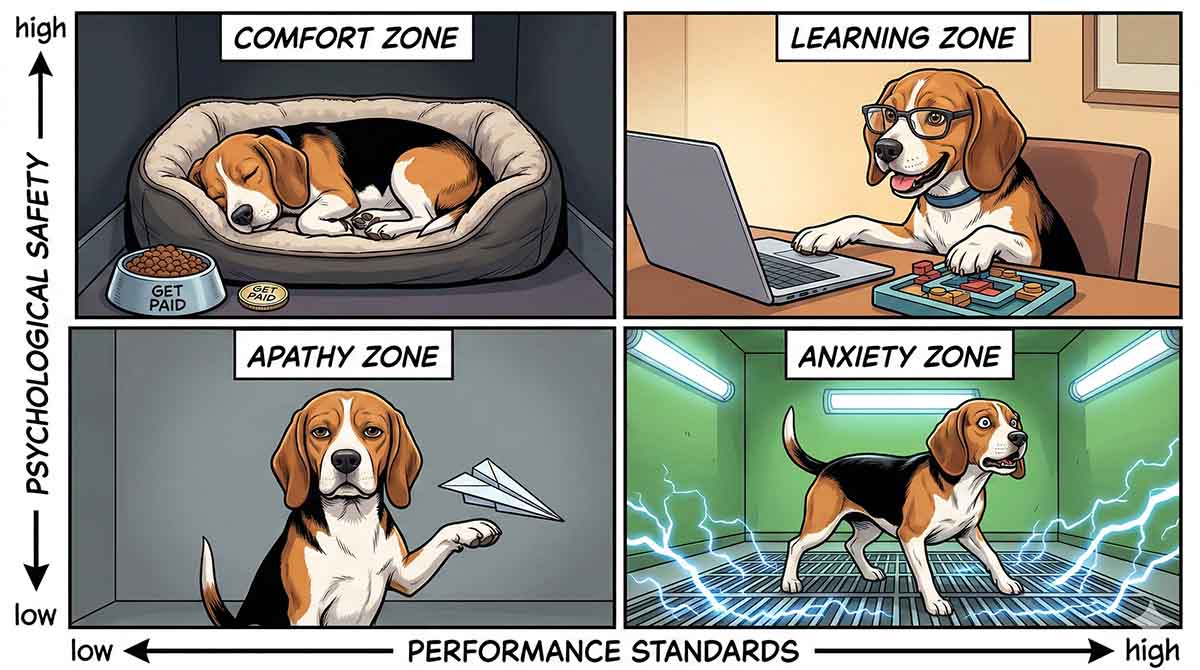
Amy Edmondson’s framework: Psychological Safety and Accountability must both be high to reach the Learning Zone.
When a lack of time makes deep and continuous feedback impossible, the system naturally shifts into the Anxiety Zone. Employees realize that their People Lead simply does not have the capacity to see their daily struggles. Consequently, employees feel forced to work for visibility. They start managing their internal PR to ensure the boss sees their achievements for the next salary review. Working for visibility is not psychological safety. It is an organizational coping mechanism.
🧠 The Breaking Point: When Dunbar’s Number Crashes the Org Chart
Let us calculate the required 1.5 hours against typical spans of control. The science of cognitive limits, specifically Robin Dunbar’s research, explains exactly why the system eventually crashes.
- 🟢 5 Direct Reports (The Toyota Baseline): ~7.5 hours/week. Toyota historically operates with teams of 4 to 6 people. Anthropologically, this aligns perfectly with Dunbar’s “Support Clique” (the innermost circle of about 5 people). Trust is deep, and the People Lead can easily do operative work.
- 🟡 10 Direct Reports: ~15 hours/week. A massive but manageable effort. People management takes up nearly two full workdays.
- 🟠 15 Direct Reports (The Red Line): ~22.5 hours/week. Science calls this Dunbar’s “Sympathy Group” (max. 15 people). This is the absolute cognitive limit for maintaining deep, supportive relationships. Over 50% of the week goes into relationship management.
- 🔴 20+ Direct Reports: 30+ hours/week. Here, the system mathematically collapses. Asking a People Lead to spend 30 hours purely on relationship building is a recipe for burnout. The cognitive capacity is exhausted. Relationships become transactional out of pure necessity.
🏢 The Enterprise Reality: Three Systemic Constraints You Cannot Ignore
Our calculation assumes a vacuum. It assumes a People Lead with 15 reports has 17.5 hours left for actual domain work. As an enterprise coach, I know this is a dangerous illusion. In a real corporate environment, the math is even more brutal due to three systemic constraints.
1. 🗄️ The Administrative Overhead
People Leads carry massive shadow tasks. They handle recruiting, budget approvals, works council alignments, compliance training, and endless strategic syncs. When we add this enterprise overhead, the system does not break at 15 or 20 reports. It often breaks at 8 or 10. Relationship work is always the first thing that silently dies in a calendar when an urgent budget meeting calls.
2. 🗜️ The Middle Management Squeeze
We demand that People Leads create a safe space. But in reality, they act as the shock absorbers of the organization. Pressure for delivery comes from the executive level above. The desire for empathy comes from the team below. Psychological safety trickles down. If a People Lead operates under immense pressure to hit operational targets without a safety net, they will inevitably pass that anxiety down to the team. You cannot build a safe room for others when your own environment is highly volatile.
3. 💰 The HR Budget Wall
Let us assume a People Lead does everything right. They build trust and evaluate fairly. Then the annual salary cycle begins. Here they encounter the inflexible reality of enterprise budgets. Compensation frameworks often rely on fixed budgets or distribution curves to keep the company financially stable. The People Lead suddenly has to rank excellent performers against each other just to fit a mathematical distribution. The trust built over months can shatter in a single compensation talk. Even the best People Lead cannot out-coach a rigid compensation framework.
🔓 The Liberating Shift: Stop Forcing Managers to Be Therapists
Here is the shift in perspective that can save our People Leads: It is perfectly fine if disciplinary leads do not create psychological safety. Their primary job is simply not to destroy it.
Psychological safety is incredibly fragile. A People Lead can spend months building it and then destroy it with a single dismissive comment. Sometimes it does not even take a specific action. Simply showing up to a team meeting can be enough. If the entire (!) team did not explicitly invite the disciplinary lead, their mere presence alters the room. The team stops brainstorming and starts reporting. The safe space evaporates instantly.
What happens if we relieve People Leads of the expectation to be the team’s therapist? What if their mandate shifts purely to individual development, career pathing, removing blockers for self-organization, and fair evaluation?
The math changes drastically. The required time drops to a realistic 30 to 45 minutes per week, per head. This works through highly focused bi-weekly development 1-on-1s and clear expectation management. Suddenly, leading 20 people takes 10 to 15 hours a week. It becomes a healthy and manageable role.
But if the People Lead steps back from the daily team dynamics, who ensures the team stays in the Learning Zone? This is where the mathematical elegance of lateral leadership comes in. Roles like Agile Coaches or Scrum Masters are built exactly for this gap. Because they hold no formal disciplinary power, they do not trigger Impression Management. Their structural neutrality gives them a massive efficiency advantage. They can establish robust psychological safety in a team of 5 to 9 people using just 8 to 12 hours a week. They do not have to fight the system. They can just facilitate it.
🕵️ The Evaluation Gap: Why Boss Observation is Counterproductive
A common counter-argument remains: If People Leads step back from the daily team dynamics, how are they supposed to fairly evaluate their reports? Do they not need to observe them?
No. In fact, observing them is counterproductive. When the person holding your career in their hands watches your daily work, the Hawthorne effect kicks in. The work turns into the theater performance optimized for the boss mentioned earlier.
Sometimes the push for observation actually comes from the employees themselves. Direct reports might actively demand that their People Lead attends their working sessions so their hard work can be seen and evaluated. But these employees fall for the exact same trap. They want to stage a theater performance to secure their visibility. It is the responsibility of the People Lead to push back. The lead must educate the employee on why the boss’s presence is harmful to the wider team dynamic. They must establish asynchronous ways to highlight value instead.
Instead of observing, People Leads can use the time they just won back to gather high-quality, asynchronous input. A fair evaluation is built on four pillars:
- 🎯 Strategic 1-on-1s: Discussing learnings, career progression, and personal goals.
- 👥 Peer Feedback: Gathering insights from the people who actually work alongside the employee. (Note: This explicitly limits feedback from lateral Agile Coaches or Scrum Masters. Coaches do not snitch. Their neutrality is sacred to preserve the team’s safe space.)
- 🏆 Team Performance: Complex knowledge work is a team sport. If the team succeeds, the individuals are contributing.
- 🏗️ Reviewing Work Results Together: Instead of having to constantly shadow daily tasks or monitor ongoing work, look at the finished results with them. Discuss the architecture, the strategic impact, or the underlying decisions in a safe, retrospective setting.
⚙️ Design Systems, Not Superheroes: Making the Math Actually Work
Trust is not just a mathematical formula. Psychological safety is often forged in defining moments. A calm five-minute reaction to a massive production bug can build more trust than ten hours of scheduled meetings.
This is true. It is also a dangerous organizational strategy.
To react calmly during a crisis, a People Lead needs cognitive reserves. An exhausted and overstretched disciplinary lead will not react with empathy when the server crashes. They will react with panic. And without a baseline of continuous trust built through regular time investment, that production bug will never even surface. The team will simply hide the mistake to avoid the Impression Management Tax. The defining moment never happens.
By decoupling disciplinary power from team dynamics, we create a system where two distinct roles play to their structural strengths.
The People Lead handles career growth, structural blockers, and evaluation without the burden of micromanaging. The lateral coach facilitates psychological safety and team performance without the friction of salary negotiations.
This division of labor is not a luxury. It is the only way the math works out. We must stop expecting perfect individuals to overcome broken structures. We need to implement an organizational design that allows normal, hard-working people to succeed.
🧾 The Receipts: The Math and the Science
Just like last time, do not just take my word for it. If you need hard data to convince your leadership team that their current spans of control are mathematically and psychologically broken, send them these studies.
Why the Best Teams Report More Mistakes: Edmondson, A. C. (1999). “Psychological Safety and Learning Behavior in Work Teams.” Administrative Science Quarterly. Review the study here.
Why We Disengage: Kahn, W. A. (1990). “Psychological Conditions of Personal Engagement and Disengagement at Work.” Academy of Management Journal. Review the study here.
The Mechanics of Trust: Mayer, R. C., Davis, J. H., & Schoorman, F. D. (1995). “An Integrative Model of Organizational Trust.” Academy of Management Review. Review the study here.
The Cognitive Limits of Relationships: Dunbar, R. I. M. (1992). “Neocortex size as a constraint on group size in primates.” Journal of Human Evolution. Review the study here.
The Perils of Boss Observation: Roethlisberger, F. J., & Dickson, W. J. (1939). “Management and the Worker.” Harvard University Press. Read the book on Internet Archive.
The Time Cost of Management: Gallup (2015). “State of the American Manager.” Review the study here.